
Honeywell Air Duct Cleaning in Charleston: A Homeowner’s Guide
If your Charleston home has a Honeywell whole-home air purifier, electronic air cleaner, or UV germicidal system wired in-line with your ducts, standard duct cleaning methods can damage the components or simply clean around them, leaving the most contaminated zone untouched. That’s the part most generic tutorials skip. So here’s the straight answer: Honeywell-integrated systems need a different protocol than bare ductwork, and it’s worth knowing the difference before anyone touches yours. If you’d rather not sort through it yourself, call (877) 792-6016.
What Makes a Honeywell-Integrated Duct System Different?
A Honeywell system isn’t one thing bolted to your ductwork. It’s a set of in-line components, and each one reacts differently to the cleaning process. An electronic air cleaner uses charged cells and collector plates to trap particles. A media filter cabinet holds a thick pleated filter that captures finer debris than a standard furnace filter ever will. And a UV germicidal lamp assembly sits in the airstream or near the coil, continuously irradiating whatever passes it. In Charleston, where humidity climbs through the summer and the AC runs hard for months, these components see a steady biological load. Duct surfaces stay damp longer, and the interiors of filter cabinets and coil housings become a natural collection point for dust and microbial growth. A standard duct cleaning that ignores these assemblies treats the duct as a closed tube. It isn’t, in your home. The Honeywell hardware is the most sensitive part of the system, and it’s usually the dirtiest.
Electronic Air Cleaners, Media Filters, and UV Lamps: Three Different Protocols
This is where a lot of residential services go wrong. They run the same brush-and-vacuum pass everywhere and call it done. Each Honeywell component needs its own handling.
- Electronic air cleaners (EAC): The charged cells and collector plates need to come out for separate wash-down. If they’re cleaned in place with a powered brush, the fine wires and plate coatings can be damaged. Reinstall and test the charge afterward, or the unit runs but doesn’t collect.
- Media filter cabinets: The cabinet interior gets vacuumed and wiped; the filter itself gets replaced, not washed. A clogged media filter starves airflow for the whole system, and cleaning around it accomplishes nothing.
- UV lamp assemblies: Lamps are delicate, and the glass sleeve needs to be wiped clean because dust film blocks the UV output. Lamps that are past their effective life get replaced, not just dusted.
A cleaning crew that treats all three the same way is either skipping steps or risking damage. In our experience, the tell is whether they ask about your specific Honeywell model before they arrive. If they don’t, that’s your first clue.
Why Negative-Pressure Cleaning Around Active UV Lamps Takes a Specific Sequence
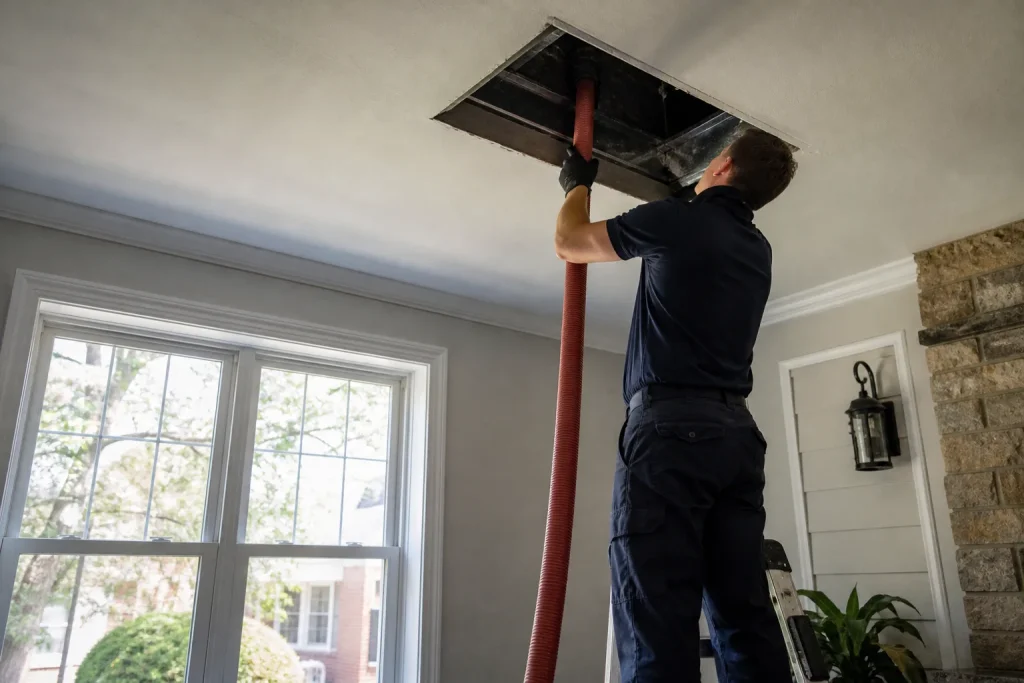
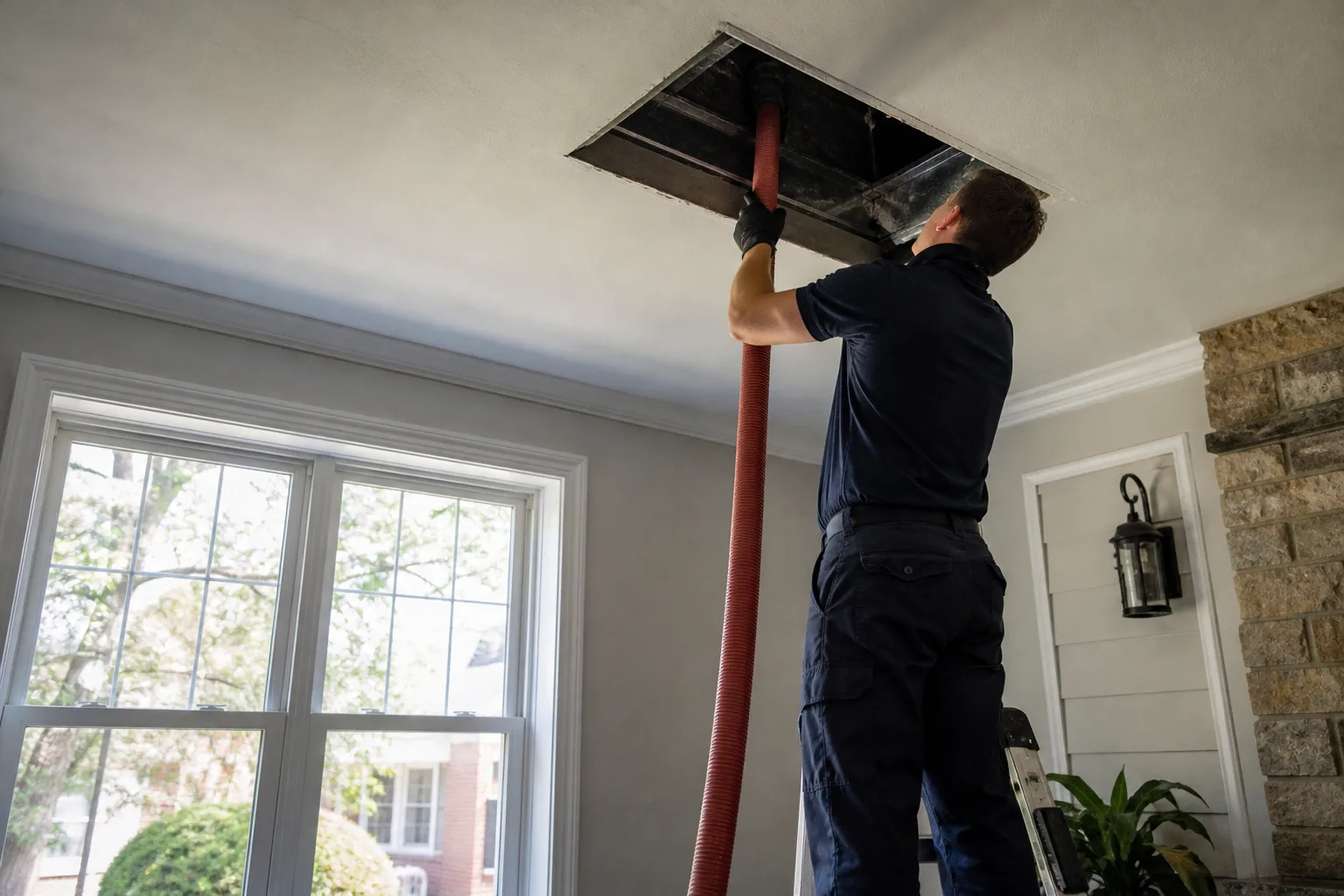
Negative-pressure cleaning is the right method for ductwork. You put the system under vacuum so loosened debris travels toward the collection point instead of into your living space. That’s standard practice and the reason professional equipment matters. But when a UV lamp is running in the airstream, the sequence has to change.
The UV system has to be powered down before any agitation begins, then the ductwork is cleaned under negative pressure, and only after the work area is cleared does the lamp come back on. Powering down isn’t the hard part. Doing it in the right order, with containment in place, is. Run a powered brush through active UV housing and you’re agitating debris into an energized zone with airborne particles moving in unpredictable directions. You also risk striking the lamp sleeve. In Charleston’s climate, where the HVAC equipment has been pulling humid air all summer and coil housings see more buildup than in drier regions, that debris volume is real. A technician who knows the sequence will confirm lamp shutdown before starting and can describe containment before the vacuum ever comes out of the van. Ask them to. It’s a fair question and a fast way to sort trained from untrained.
Two Different Jobs: Cleaning the Ductwork vs. Cleaning the Honeywell Unit
This is the conflation we see most often. Homeowners understand they bought a Honeywell system and expect the cleaning to cover it. But cleaning the ducts that feed the system and cleaning the Honeywell unit itself are two separate scopes, requiring different tools and often finished at different times.
Duct cleaning covers the trunk lines, branch runs, registers, and the return path that carries air into the equipment. Component service covers the inside of the air cleaner, filter cabinet, and UV housing. A thorough job does both, but a company that only quotes “duct cleaning” may not have planned for the second scope. That’s why we lay out the full job, per system, as one flat price before work starts. No surprises mid-job when the technician finds a media cabinet that needs attention. Ask for before-and-after photos of your own duct interiors and your own components. You should be able to see what was there and what’s not, rather than take anyone’s word for it.
How to Confirm a Technician Actually Knows Honeywell Systems
You don’t need to become an HVAC tech to ask the right questions. A few quick ones sort it out. Ask what model EAC or media cabinet sits in your ductwork and whether they’ll service the component or clean around it. Ask how they handle UV lamps during cleaning, and listen for “power down first.” Ask whether they carry professional-grade equipment. At Charleston Air Duct Cleaning Pros, we use Rotobrush and Nikro systems on every job, along with Abatement Technologies containment equipment, because the heavy-duty class of tool is the only thing that actually pulls the load these systems create. And we work with Honeywell and Aprilaire product lines directly, which means the components don’t get treated as a mystery. Our technicians have up to 14 years of experience on systems from basic to fully integrated.
What a Properly Serviced Honeywell System Should Do After Cleaning
You should notice results within a day or two. Airflow through the registers should be stronger and more even from room to room. If your HVAC was starved by a clogged media filter, the system will cycle more easily, and that usually shows up in your energy bill. Odors that linger in a Charleston home through the humid months should ease once the coil housing and duct surfaces are clean. Particle readings, if you run a monitor, should drop and stay low longer. A UV lamp that’s been properly cleaned and is within its effective life keeps the coil surface from developing new growth, which is the whole point of having one. If airflow doesn’t improve and odors return within a few weeks, the cleaning didn’t reach the source. That’s worth a call back to whoever did the work.
When to Call a Pro
If your home has a Honeywell air cleaner, UV system, or media cabinet in line with the ducts, and you’re not certain the last cleaning addressed those components, it’s time to bring in a professional. Amateur cleaning of energized UV assemblies and charged EAC cells can knock a component out of service and, in the case of UV, put you near energized equipment you shouldn’t be tinkering with. This is genuinely not a job for a shop vac and an afternoon. A trained technician will power the system down, contain the work area, and inspect the components individually.
Related services in Charleston: our air duct cleaning page covers the standard full-system scope, and our HVAC cleaning service handles the equipment and coil side when buildup is the problem. If your dryer vent needs attention too, dryer vent cleaning is on our menu for fire-prevention reasons.
The Bottom Line
- Honeywell EAC, media filter, and UV lamp components each need different handling during cleaning; they can’t be cleaned like plain ductwork.
- The duct cleaning and the component service are two separate scopes. Confirm both are covered.
- UV lamps must be powered down before agitation begins and only restored after containment is cleared.
- Ask what equipment a company uses. Rotobrush, Nikro, and Abatement Technologies systems are what belong on a job like this.
- Professional work costs more than a blow-out, but it lasts, and it doesn’t void your equipment warranty.
If you’re in Charleston and need help, Charleston Air Duct Cleaning Pros offers free estimates. Call (877) 792-6016. We answer 24/7. Fast dispatch from 7am to 7pm, Sunday through Friday.
Frequently Asked Questions
Yes. A powered brush applied to EAC cells and collector plates can damage the fine wires and plate coatings, and agitating debris near a running UV lamp risks breaking the sleeve and pushing particles into an energized zone. Ask whether the technician knows the power-down sequence and component handling before work starts. Call (877) 792-6016 for an estimate on proper servicing – it’s free.
Yes, they’re separate scopes. Duct cleaning covers the trunk lines, branches, and returns, while the Honeywell components (EAC cells, filter cabinet, UV housing) come out or get serviced individually. A complete job covers both. Ask for a quote that names both, with before-and-after photos. Call (877) 792-6016 to schedule.
A common interval is every one to three years depending on household dust load, pets, and how hard the AC runs. Charleston’s humid summers can push buildup faster than drier climates, so it’s worth having the system inspected sooner if you notice odors or reduced airflow. Call (877) 792-6016 for a walk-through and a straight answer.
Professional-grade duct cleaning equipment and containment: Rotobrush and Nikro systems, Abatement Technologies air-containment, and UV/component handling knowledge. A consumer shop vac isn’t the right tool. Ask before you book. Call (877) 792-6016. We answer 24/7.
Written by the team at Charleston Air Duct Cleaning Pros.
Need Air Duct Cleaning Help?
Call Charleston Air Duct Cleaning Pros - the local pro we connect you with is licensed and insured, here with fast help in Charleston.
(877) 792-6016