
How to Choose the Right Air Duct Cleaning Company in Charleston
Choosing a duct cleaning company in Charleston comes down to asking three questions before anyone arrives: what equipment will be on the job, can you show me the scope in writing, and how will you prove the work was done? Get direct answers to those and you can tell a professional operation from a bait-and-switch in about five minutes on the phone. If you’d rather skip the vetting and talk to us directly, call (877) 792-6016.
Here’s the uncomfortable part of this industry: there’s no universal licensing requirement for duct cleaning, so “cheap” and “highly rated” can sit side by side in Charleston search results with nothing but a star count separating a real operation from a $99 come-on. The EPA has explicitly stated that most low-priced duct cleaning offers are associated with bait-and-switch fraud, which makes rating scores a dangerously unreliable filter on their own. What actually separates companies is far less glamorous: the equipment under the hood, the paperwork behind the quote, and the questions a technician is willing to answer before they touch a single vent.
This guide is the checklist we’d hand a friend in Charleston. Use it on any company, including ours.
What questions should you ask a duct cleaning company before booking in Charleston?
Ask these five questions on the first phone call, before any visit is scheduled. A company that handles duct work professionally answers all of them plainly. A company that dodges, gets vague, or promises a price “once we get out there” has told you what you need to know.
- “What equipment will you use?” The answer should name real equipment and real systems, not “industrial vacuums.” If they can’t describe the machine, they probably don’t own a serious one.
- “Will you inspect the system before quoting?” A legitimate company visually inspects the supply and return layout, the duct material, and any existing damage before committing to a scope.
- “What’s the written scope of work?” You want a document that names each component being cleaned, sealed, or repaired, not a one-line invoice.
- “How will you document the result?” Before-and-after photos of your own ducts should be standard. Ask outright.
- “Are you NADCA members, and where’s your access hole repair plan?” Cutting into ductwork is normal for cleaning; leaving the holes open is not. Ask how access holes get sealed afterward.
Any company that answers all five clearly on a phone call is already in the top tier of what you’ll find in Charleston. The rest of this guide explains why each question matters.
The three equipment questions that separate professional operations from shop-vac setups
Equipment is where underprepared operators get exposed, because the gap between a real duct-cleaning system and a portable shop-vac rig is enormous and hard to hide once you know what to ask. Here are the three technical questions worth pressing on:
- What’s the CFM rating of the machine? CFM (cubic feet per minute) is airflow capacity. Professional truck-mounted and high-end portable systems pull thousands of CFM, which is what actually evacuates debris from a whole-house system. A shop-vac pulls a fraction of that and pushes as much dust back into the room as it removes.
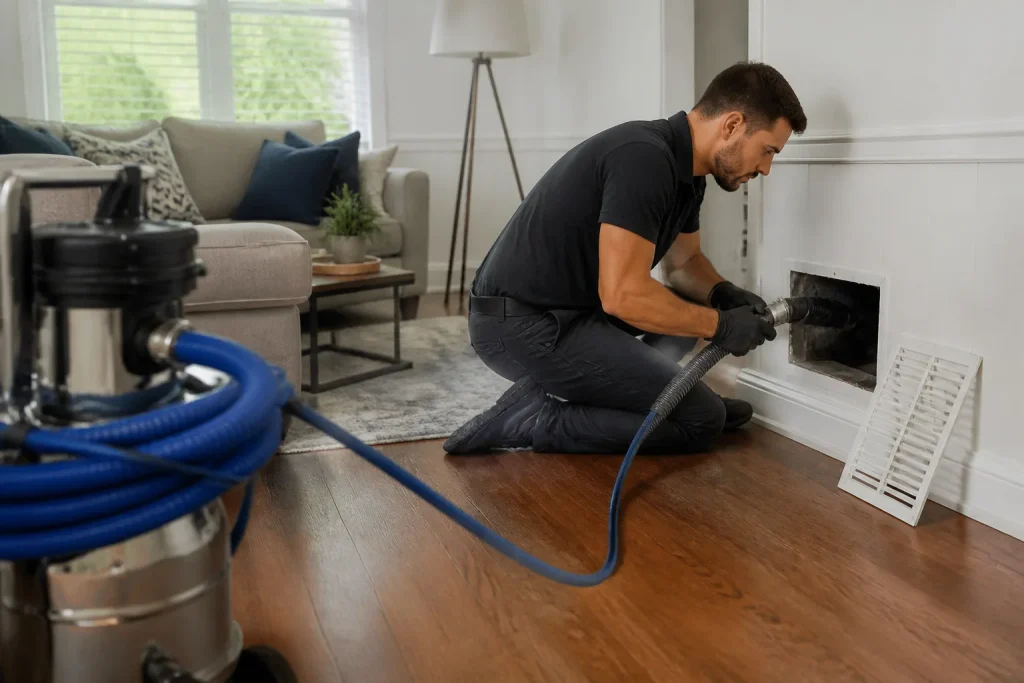
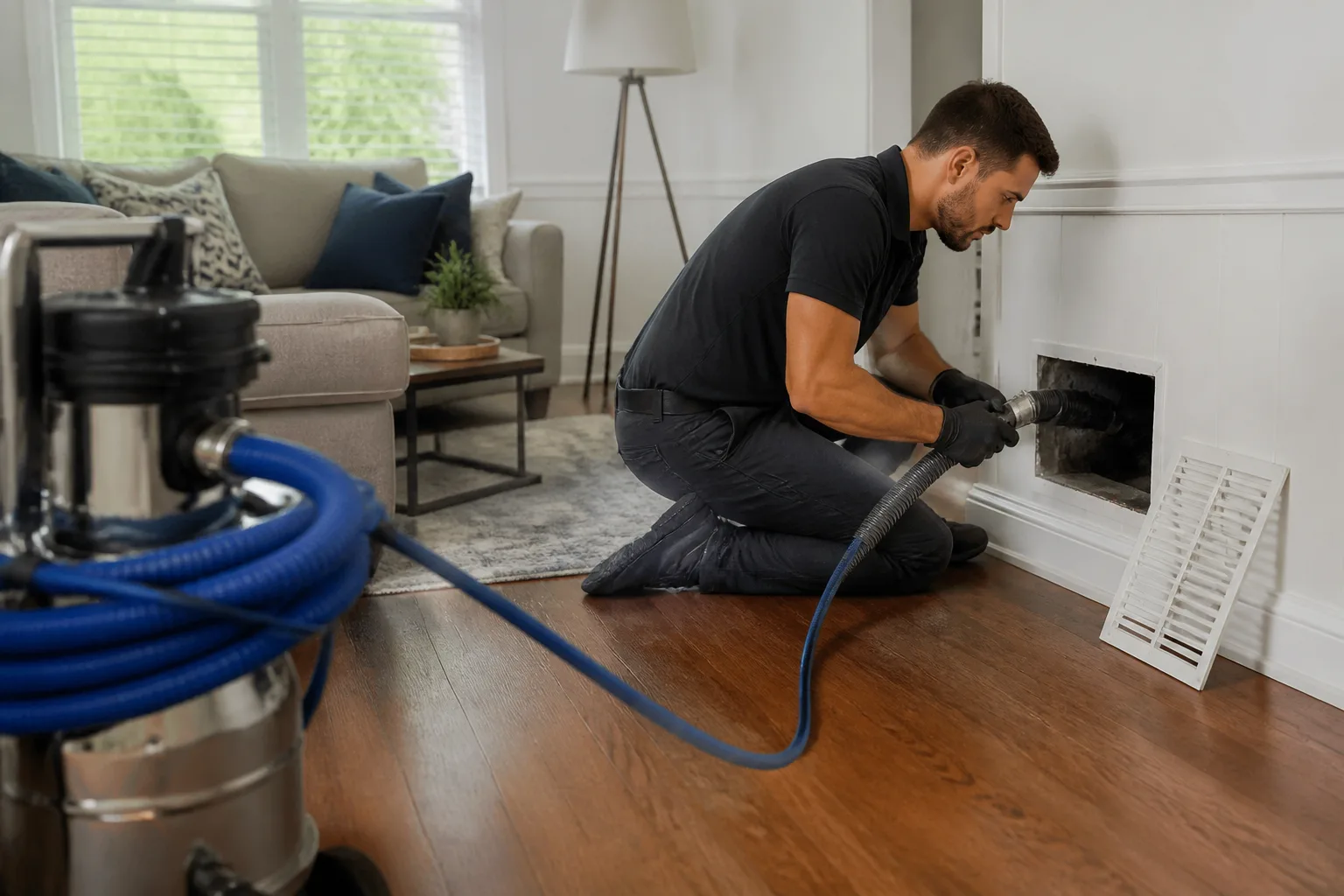
- Is there HEPA filtration on the vacuum? HEPA filtration traps fine particulate instead of re-releasing it into your home. A legitimate system includes HEPA-grade filtration and often containment equipment. We run Abatement Technologies air-containment gear alongside Rotobrush and Nikro duct-cleaning systems for exactly this reason: commercially rated equipment belongs in a house too, and containment keeps the job clean while it’s happening.
- Are the brush heads matched to my duct material? Flex duct and sheet-metal duct need different heads and different pressure. A company that uses one head for everything is cleaning on autopilot. Ask specifically whether they’ll match the approach to your system’s ductwork type.
None of this is exotic. It’s just the difference between a company that bought a real system and one that didn’t. In Charleston, where housing stock ranges from older homes with retrofitted ductwork to newer construction with tight flex runs, the equipment question matters more than almost anything else.
Why NADCA membership is worth checking, and how to verify it in 30 seconds
NADCA (the National Air Duct Cleaners Association) is the trade body that publishes the recognized standard for how duct cleaning should be done. Membership is a meaningful signal because it requires a company to commit to that standard, stay current on the science, and follow a documented process rather than improvising with a vacuum. It’s not a government license, but in an unlicensed field it’s the closest thing to one that’s actually verifiable.
Verifying it takes half a minute. NADCA maintains a public member directory online; you look up the company name and confirm it’s listed. If a Charleston company claims membership and doesn’t appear, that claim just told you how much weight to give everything else they said.
We’re members, and we mention it not as a badge but because we’ve seen how quickly a membership check flushes out operators who’ve spent more effort on their website than their equipment. Run the check on us too. It should take you longer to type the URL than to read the result.
The red flags that should end the conversation
Some quotes announce themselves as trouble. The clearest red flags in Charleston duct cleaning are:
- Flat-rate whole-house pricing under $200. Whole-house duct cleaning requires equipment and labor that plain don’t fit under that number. That price isn’t a discount; it’s an entry point, and the real invoice arrives after the technician is inside.
- No visual inspection offered. A company quoting a full system without looking at it is guessing, and guesses get corrected on-site at your expense.
- No mention of access-hole repair. Cleaning often requires cutting into ductwork. A quote that doesn’t address sealing those cuts is a quote that leaves you with an air leak.
- Pressure to book on the first call. Legitimate work doesn’t require urgency tactics to get scheduled.
- One price for every house. Duct systems vary. A quote that never asks about yours isn’t a quote.
In our experience, the bait-and-switch pattern follows a script: a cheap advertised number, a technician who “discovers” contamination, and a final price several times the original. The questions above exist to short-circuit that script before it starts.
What a legitimate multi-stage process looks like on paper
A real duct cleaning job is a sequence, not a single step, and the written scope should reflect that. When you review a quote in Charleston, look for these stages spelled out:
- 1
Inspection of the supply and return system, noting duct material and any damage.
- 2
Containment and setup, so the work area stays controlled while cleaning happens.
- 3
Cleaning of registers, trunks, and branches using equipment matched to the duct type.
- 4
Repair or sealing where damage or leaks are found, and closing any access holes cut during the job.
- 5
Sanitizing, when microbial contamination is a concern, using a product line built for it.
- 6
Documentation: photos, and a written record of what was done.
A one-step “blow-out” disguised with technical language usually skips stages two, four, and six. Dust gets loosened, some of it gets removed, access holes get left open, and no proof is offered. That’s not cleaning; it’s movement. The full lifecycle, cleaned, sealed, and sanitized, is what a proper scope describes, and it’s also why a legitimate process touches more than duct cleaning alone: often the dryer vent and the HVAC cabinet come into the conversation. You can read about those services at dryer vent cleaning and HVAC cleaning.
What documentation should you get after the job?
Ask about documentation before the job, not after. You want three things: before-and-after photos of your own ducts, airflow readings where the system allows, and a written confirmation of the scope that was performed. Photos are the simplest test. If a company can show you clean metal and a clear plenum after the work, they did the work. If photos “aren’t part of the package,” that’s an answer too.
We’ve also seen how a proper scope does something else: it keeps the conversation honest. When the scope is written down and the photos are attached, there’s nothing to argue about afterward. We repair what we find, and we document both the finding and the fix, so the record matches the invoice. In Charleston, where humidity and older ductwork both push homeowners to look closely at what’s inside their walls, that paper trail is worth more than any rating badge.
If your system also needs repair or air-quality work, the full air duct cleaning service page covers the lifecycle we’re describing. And if the dryer vent hasn’t been touched in years, that’s a fire-prevention question separate from duct cleaning; it’s included in the Charleston Air Duct Cleaning Pros service list for a reason.
The Bottom Line
The right duct cleaning company in Charleston is the one that answers your equipment questions without flinching, shows you a written multi-stage scope, repairs access holes, and hands you before-and-after photos of your own ducts. Ratings alone won’t tell you any of that. Neither will the size of the advertised price. The five opening questions in this guide will.
If you’d rather have a conversation than run the whole checklist yourself, we’re happy to answer the questions anyway. Charleston Air Duct Cleaning Pros offers free estimates, and we’re not shy about naming the equipment on the call. Call (877) 792-6016. We answer 24/7. Fast dispatch from 7am to 7pm, Sunday through Friday.
Frequently Asked Questions
There’s no single number, but whole-house duct cleaning is priced per job based on system size, duct layout, and what gets found during inspection, not per-vent. The written estimate sets the final price, so get it before work begins. Be wary of any whole-house quote under $200; it’s a pitch, not a price. Call (877) 792-6016 for an exact quote; estimates are free.
Because the cheap ones don’t cover the same job. Under-$200 whole-house quotes typically skip visual inspection, use shop-vac-grade equipment instead of professional systems with HEPA filtration and containment, and leave access holes unsealed. The low number is the entry fee; the real cost shows up later. Ask what equipment and process the quote includes. Call (877) 792-6016 and we’ll walk you through ours.
Ask for before-and-after photos of your own ducts and a written scope of work noting what was cleaned, sealed, and sanitized. These should be part of any professional job, not a special request. If a company can’t produce them, assume the cleaning was as vague as the proof. Call (877) 792-6016 to ask about documentation on our jobs.
There’s no universal schedule; it depends on your home, your duct material, and what’s circulating. Visible dust streaking at registers, new allergies or odors that worsen when the system runs, recent renovation, or a system that’s never been cleaned are the usual triggers to look inside. When in doubt, have the system inspected. Call (877) 792-6016 and we’ll help you decide if a cleaning is actually warranted.
Written by the team at Charleston Air Duct Cleaning Pros.
Need Air Duct Cleaning Help?
Call Charleston Air Duct Cleaning Pros - the local pro we connect you with is licensed and insured, here with fast help in Charleston.
(877) 792-6016